How to Lay Out and Square Up Your Hoop Barn
Getting your layout right is one of the most important steps in building a hoop barn. If the corners are even slightly off, it can cause major issues later such as poor frame alignment, uneven fabric tension, and structural stress over time. A properly laid out and squared site saves you money, time, and frustration during installation and long-term use. Most agricultural building guidelines, including university extension recommendations like AEN-152-style farm structure principles, emphasize that accurate site layout is the foundation of a durable agricultural building.
Tools You’ll Need Before You Start
Before starting, you only need a few basic tools that are commonly used on farm construction sites. These include 2×4 wooden stakes (about 4 feet long), batter boards for holding your string lines, mason or layout string, a hammer with nails, and a 100-foot measuring tape. Nothing specialized is required—just simple, reliable tools that help you establish accurate measurements on the ground.
Setting Up Your Layout and Batter Boards
Begin by marking the rough location of your barn. Identify where you want the four corners to sit, but don’t focus on precision at this stage. The goal here is to roughly outline the building footprint. Drive stakes slightly outside your intended barn area—usually about 2 to 3 feet beyond the final corners. This extra space allows you to adjust your layout without disturbing the ground markers later, which becomes very important during squaring and excavation.
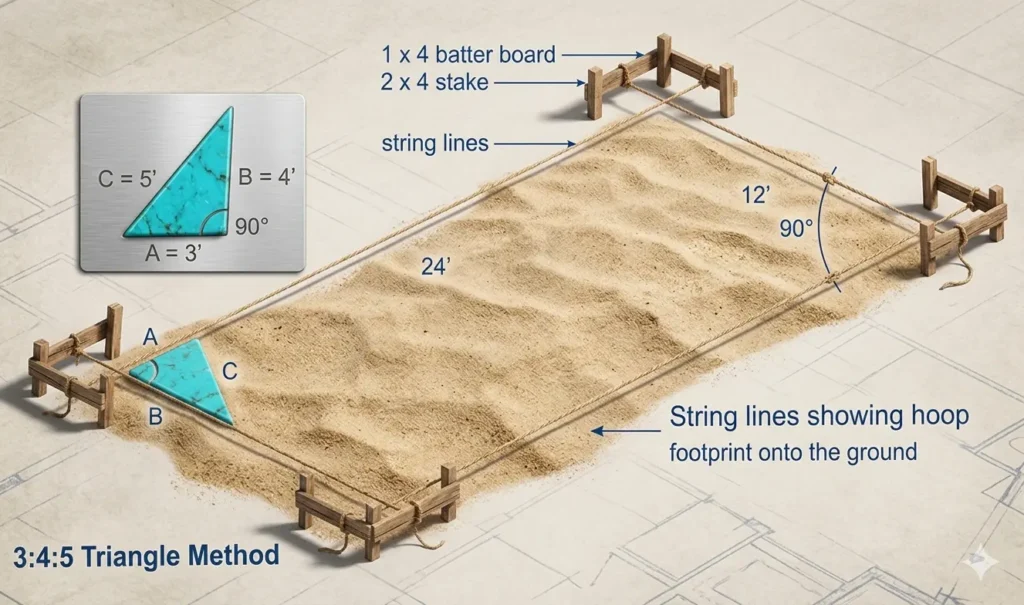
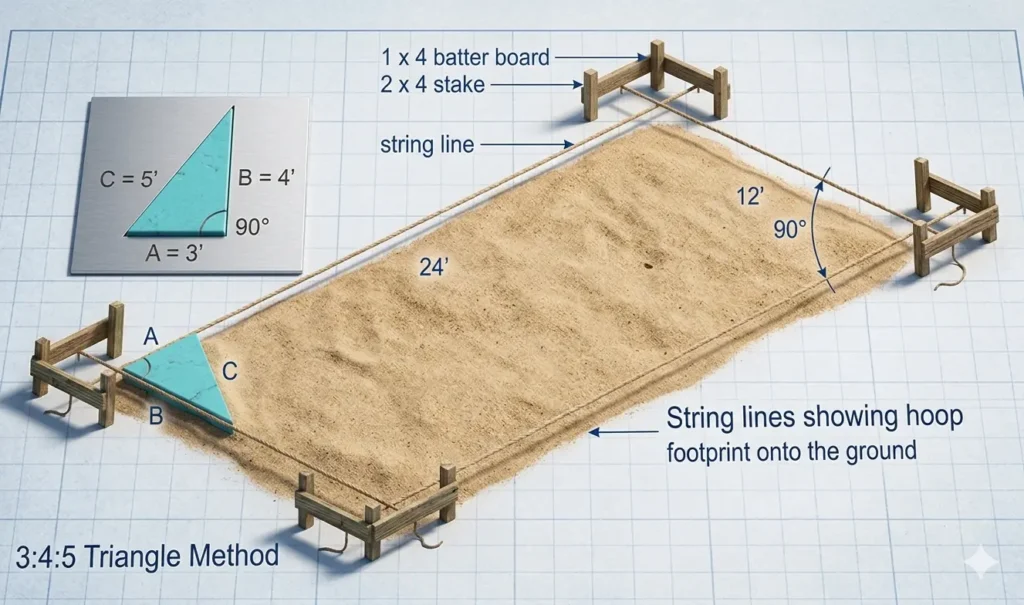
Next, install batter boards near each corner stake. These boards act as adjustable anchors for your string lines and make it much easier to fine-tune your layout. Once the batter boards are in place, run string lines between them to form the outer perimeter of your hoop barn. This string outline represents the exact footprint of your structure, so take your time to get it as close as possible before moving on.
Checking Level, Grade, and Drainage Before Final Squaring
Before you finalize your measurements, take a moment to check the site conditions. A hoop barn should always be placed on ground that is as level as possible or properly graded. Even a slight slope can affect drainage, structural stability, and how evenly the building settles over time. Walk the site and make sure water will naturally drain away from the structure, not toward it. If needed, plan for gravel, compaction, or minor grading adjustments before final layout is locked in. This step is often overlooked, but it directly impacts the long-term performance of agricultural buildings, especially fabric-covered structures.
Squaring the Structure and Final Checks
Once your basic shape is set, the next step is making sure the structure is perfectly square. This is critical because even small errors at this stage can carry through the entire build and affect frame alignment, fabric tension, and overall stability. Agricultural construction relies on simple but accurate field methods to confirm squareness before any permanent work begins.
3-4-5 Triangle Method
The 3-4-5 method is one of the simplest and most reliable ways to square corners in the field. You measure 3 units along one side and 4 units along the adjoining side, then adjust the corner until the diagonal between those points equals 5 units (or a scaled version of 3:4:5 for larger barns). When the ratio is correct, you have a true 90-degree angle. This method is especially useful for setting your first corner accurately before expanding the rest of the layout.
Diagonal Measurement Method
The diagonal method is used to confirm the entire structure is square after all corners are roughly set. You measure from one corner of the barn directly to the opposite corner, then repeat for the other diagonal. If both diagonal measurements are exactly the same, the structure is perfectly square. This method is particularly effective for larger hoop barns where small errors can compound over long distances.
Final Checks
Once both methods confirm squareness, recheck all string lines for tension and alignment. Make sure nothing has shifted before moving on to excavation or foundation work. Many experienced builders use both methods together to double-confirm accuracy, especially on large agricultural structures where precision is essential for long-term performance.
After squaring, make final adjustments to ensure all string lines are tight, straight, and properly aligned. Recheck your measurements carefully before moving forward. Once everything is confirmed, your site is ready for the next phase, whether that involves building a pony wall, marking post holes, or preparing for a concrete foundation.
At this stage, the most important thing to remember is that accuracy matters more than speed. A well-squared layout is what ensures your hoop barn goes up smoothly, stays structurally sound, and performs well for years under real farm conditions.
Common Mistakes to Avoid During Layout
One of the biggest issues farmers run into when laying out a hoop barn is rushing the process. Even though the structure itself is relatively fast to build, the layout stage is where most long-term problems are created. A common mistake is relying only on visual alignment instead of using proper measurements. What looks “straight enough” in the field is often off by several inches, which becomes a major problem when stretching fabric or setting the steel frame.
Another frequent error is placing batter boards too close to the intended building footprint. When there isn’t enough offset distance, it becomes difficult to adjust string lines accurately. This limits your ability to correct small errors, which defeats the purpose of using batter boards in the first place. Keeping enough clearance—usually a few feet outside the structure—gives you flexibility and control during adjustments.
Farmers also sometimes forget to recheck diagonal measurements after making changes. Any adjustment to one corner can affect the entire layout, so squaring should always be verified multiple times before moving forward. It’s also important not to skip final tensioning of string lines. Loose strings can shift slightly in wind or when bumped, leading to inaccurate readings.
Lastly, avoid starting excavation work before the layout is fully confirmed. Once digging begins, correcting mistakes becomes expensive and time-consuming. A few extra minutes spent double-checking measurements can prevent costly rework later and ensure your hoop barn goes up straight, level, and ready for long-term agricultural use.